Showing posts with label disappointment. Show all posts

8 October 2013

Letter to the BBC: hands off Ancient Greece!

Where I belongs, reader
Dear BBC - specifically to those in Drama Development,

I had not really been aware of your latest drama that occupies the Saturday primetime spot, Atlantis. Despite the show's content being Ancient Greece, it had not really registered. I happened upon the opening episode when it aired last week.

I am sorry to say that disappointment doesn't really adequately describe the feeling attributed to watching this show. My emotional arc can be summed up thus: eager anticipation, bemusement and then outrage.


Yes, outrage, which might seem a little of an overreaction to fiction. But here is my issue or gripe, as it were: Ancient Greek history and mythology (any mythology, for that matter) is a trove of immense storytelling. Most of it is nuts and that's why it's so enjoyable. But I believe BBC, you have handled this material with little regard and decency. It was so, so poor and I do not think it unreasonable to expect a little more from your institution. Though perhaps this is my error - I should not expect so much, I should resign myself to the fact that a whole load of nonsense comes out of your shows. However, that's not entirely true - you've got Sherlock, among other fine dramas. I understand Saturday evening is a 'fun time' slot and has been inhabited by equally silly but somewhat 'fun' shows like Robin Hood and Merlin.

I just don't understand the need to do away with a little authenticity in favour of cheap thrills. It's one thing to have poor writing and poor acting, quite another to trample over quality source material. Mythology and Ancient Greek is a bit of fun but can we at least get some simple details right, so that young people (any people) are at least educated a wee bit as well? Alas, I did not watch the entirety of the show - after 15 minutes or so, I was crying out at the TV screen, which is never good for one's blood pressure, so to ease it, I switched off. I quite literally cannot judge the rest of the episode but I can say that watching that much alone has induced quite a reaction in me.

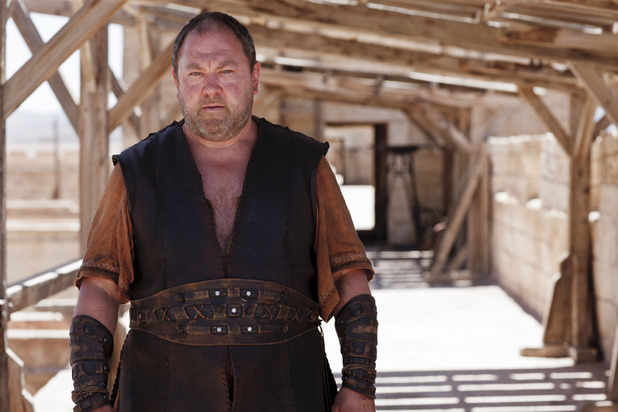
I am not going to mention the predominant Anglo-Saxon ethnicity of the casting - Robin Hood and Merlin were authentic in that sense but are we still stuck in the 1960s? There are no shortage of talent you could employ. Instead, for reasons I know not why, Mark Addy, the kind of portly man who you'd have a pint with, seems to get noble and warrior-like roles, such as King Robert in Games of Thrones. Here, you have him as Hercules, despite his utter lack of warrior-ness. Bemusing. Worse still, he's got a Roman name. Is it so immensely difficult to have him referred to as 'Heracles', as that is Greek after all. And let's get one thing sorted right away - Heracles would not, WOULD NOT, be afraid of the Minotaur. That is woefully poor on the writer's part, woefully. It would have worked if the Heracles in question was in fact a young man, as yet to take part in his trials and so was not a schooled warrior.

WHAT THE HAY?! moment:
Wait, what? This guy is the infamous Hercules?!! But he's scared of the Minotaur...*SIGH*
That brings me to the depiction of 'the oracle'. There was little or no mysticism around this ridiculous character. An oracle is not a person but rather the person - woman rather - is a vessel for the oracle. She is also not someone who just answers random questions. As such, the writers leeched any real suspense (or coolness) around that scene where the protag visits her.

Of course, these are by the by, one could argue. I would argue it just comes off as embarrassing. I would also state that the reason I get so irate watching something on this subject is because I know that I would have created something of better quality. I do not believe I am coming from an arrogant, deluded position here; I absolutely adore Ancient Greece and her mythology and I am dying and so unbelievably keen to get my hands on something that I can then work with and bring to life (of course, I am writing my own material that will adequately reflect what I mean). I don't get overly excited about much but if anyone comes to me and mentions Ancient Greece, I'm there with bells on.

I can also tell you, there is nothing mutually exclusive about being true to their culture and stories AND being fresh and bringing something exciting to the audience. We've got it in our heads that people won't like it if it sticks too much to a traditional approach. You can be as creative and mad with a story that still holds true to the original setting or tales that come from that story (Scott's Gladiator is a fab example). In fact, that is the only way you can add true value, true meaning to a new telling. I could in fact forgive more if it was a modern adaptation/set in a more modern era. But if you are going to set it in Ancient Greece, goodness, do justice to that at least! Or step aside and let those who will do it worthily.

Lastly Ancient Greece is the home to drama, the kind of drama that we love and still sustains us. There is no end to the ridiculous high stakes situations and scenarios that run through their tales. So it's still mind boggling and immensely frustrating that anyone/group of people can fail to do it right, when it's already there - very richly so!

I highly doubt you'll care much that lil' ole me is not going to be a viewer of Atlantis. But if you'd done it even a little decently, you would have had an AVID viewer and advocate. Now, I'll just seek comfort in the saying, 'If you don't like the way it's done, see if you can do it better.' I shall sirs and madams, I shall indeed.


3 September 2013

A fast and slow learner: disappointment, proactive, gut instinct and take heart.

I'm thinking about 'disappointment' - the word, what it feels like, all the stuff relating to and around the this state. I know within myself that I've probably sat in this state and thought on it too long for my own good, so apologies, this is one of those posts that is more to do with 'getting it off my chest', as it were.


I'm reading the 'Etymologican' by Mark Forsyth, a brilliant read on, yup, you guessed it, etymology of words and phrases. Tis a fascinating read indeed. So when I pinpointed my recent morose state as being grounded in 'disappointment', I wanted to understand the word's structure. Without needing to run to the internet or an actual book dictionary, I could surmise that it was a state of 'non-appointment', or opposite to 'appoint' in some way. And golly, did that strike a chord. Because it's only in that small crack of illumination around the word's construction that it resonated more in terms of reflecting my inner-goings on. Anyhow, so in confirmation of my basic pondering around the word:
Disappoint is traced to the Middle English disappointen by way of the Old French desapointer. In literal meaning, it is to remove from office.[5] Its use in the sense of general frustration traces to the late 15th century, and it first appears recorded in English as an emotional state of dejection in the middle 18th century.
I'm beginning to think disappointment is one of the heaviest and most crushing states. Depending on when it flares up, one can shrug it off. 'Oh, they didn't have the ice-cream flavour I wanted.' Not the end of the world. Sure. But we humans seem to have a 'cumulative' emotion meter. It adds up over time, nay?

It's all come to the fore much more when I happened to be at my folks' place the other day and was clearing out a big ole storage box of stuff that had all work from high school. Among my trove of wonders, I found loads of cards my friends and I had written to each other at birthdays and more generally - and man did we gush about each other! I was genuinely touched to read over some of the messages and it shocked me to realise that version of myself had existed and that I'd forgotten those thoughts. Now, I for one, adored high school.  It was an all girls school and a lot of people immediately think 'oh no, it must have been bitchy and nasty.' It really wasn't for me. School was there to nurture me, it had possibilities and because I had that attitude, it did. It's evident in my friends' messages too - we had this constant back and forth of 'lifting each other up.' Lastly, having flicked through my old AD work at uni, I could see how proficient I was at a job I didn't even get officially trained for. I taught myself; it's a pattern of mine - more on that later.
Courtesy of http://www.loveandlaundry.com/

Why do I recount my reminiscing? Because we forget. We forget really easily - how fired up we could be, how fearless we could be, how nice we could be, how wonderful we are. I know this sounds like self-help do-da but having that inherent knowledge, that inherent reassurance that doesn't need to be pushed and pulled forth from murky depths, allows one to just go forth, strike out and do things - achieve things - without a second thought. It does away with the umming and aaahing, the hesitation, the procrastination, the fear of failure and so there is an efficiency to life, there is an immediacy.

So, we then also forget the inherent lessons silently wrapped up in those past experiences. Or rather, I forget. It takes me a long, long time to a) work out why I feel 'off', b) remind myself that I can switch that around and that I was once (am) confident without thought c) remind myself that I've been through a decent amount of experiences that have allowed me to overcome a great deal (failing to achieve in one's career should be child's play compared to overcoming severe health problems and breaking free from a poisonous home environment) d) get excited and fearless and e) ACT ON IT. In fact I can get through a to d rather swiftly. It's the gap between the D and E. There should be no gap whatsoever. D should roll into E seamlessly.

That brings one to the popular and much used word, 'proactive.'
 The author, Austrian existential neuropsychiatrist Dr. Viktor Frankl, used the word to describe a person who took responsibility for his or her life, rather than looking for causes in outside circumstances or other people. Frankl stressed the importance of courage, perseverance, individual responsibility and awareness of the existence of choices, regardless of the situation or context.[4]
I think that's the catapult, the voltage between D and E. All the other stuff is 'analysis', the mind's work. The next part requires the body, essentially yes, the heart. Hence the phrase, 'take heart.' And also 'gut instinct.' I think I need to be aware of those a LOT more. It's weird though. I applied this all in terms of my journey to health. I did away with the usual thinking and methodologies around medicine, the stuff that's just assumed, just taken for granted and so would have left me with 'making do.' I questioned everything and then my gut and heart told me, 'there's another way!' It was a whisper at first and then it became a yell. 'How dare you make do?' So I acted on that inherent listening. And success and triumph followed.

So, I'm sitting here, having written this all and wondering, why do I fall short of applying this to the world of work? I should be fearless here. I should be able to sever all ties to 'maybe this might happen', 'maybe that'...blah blah. The mind is NOT my friend in this scenario. If I know that 'making do' was never my mantra, never my truth, then hell, what's the hold up? I'm writing this from my flat that I live in with my sister, a place I couldn't even begin to imagine living in this time last year. But I'm here.

So what I can understand from all this over-thinking? That only you can make stuff happen. Sure, with the flat, I had my sister's support and family's. Ditto with the health stuff. Yet at the heart of it all, it was also just me. The alternative is 'relying on others'.

This weekend I was involved in the a short film being made. I work for the director and had come on board having done film at uni, ready to make...well, films. He told me about his film ideas. I was happy to get a job. Six months went by and I'm filling in all manner of roles because it's a startup. A year later and we're only doing corporate work because that's what 'pays the bills'. I've racked up  skills as video presenter, voice over narrator, in website customisation, all just to facilitate and I was happy to get thrown in and do it. It continued that way for three years. Finally, we start to get the film made and that hopeful young woman who wanted to make films was happy. Then disappointment reared its head. In this scenario, it was 'relying on others' that did it: waiting for some people to get their stuff in order, waiting for them to recognise your worth, how much you've helped, how much you've supported them when the chips were waaaay down, even stepping back and allowing them to grow in the hopes that you'll be in the frontline when they finally do work that means something to them. Just being there. And then annoyed because you didn't fight more, you didn't yell like your heart and your gut were yelling at you. You got sidelined.

Hence, disappointment is crushing - because when all is said and done, at the heart of it, you're angry with yourself. And disappointing yourself is like nothing else. You can't project it onto objects, i.e. someone, a situation, a scene (I mean you can for awhile but's all fallacy). While disappointing others is never good, I can bear it. I can even bear it when others disappoint me but more often than not, it's my issue and not theirs. I cannot bear disappointing myself.